
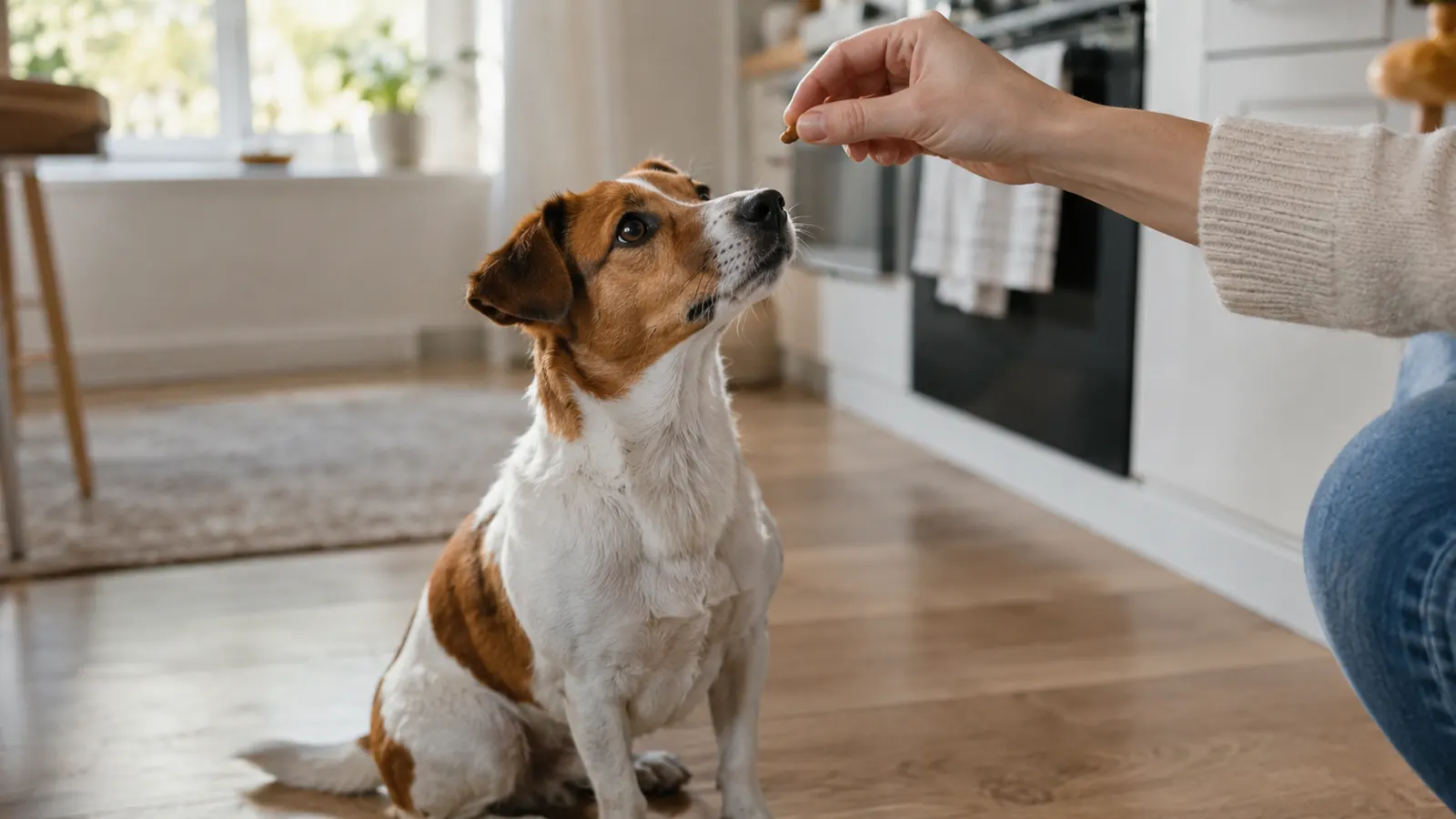
I used to call Maisie from the back door and hope. She would look up from the fence line, ears halfway up, and I could almost see her doing the math. Sometimes she came. Sometimes she went back to sniffing. That is a helpless feeling when there is a road at the end of the driveway. I knew the answer was not a louder voice. It was a better reason to come. So I started a recall plan in my own kitchen with a bag of Blue Buffalo Bits and a dog who loves food more than almost anything. The whole plan took about five weeks, and it worked. Here is exactly what I did.
Maisie is a five-year-old beagle mix, about 26 pounds, and she is very food-motivated. She also has a sensitive stomach, so I have to be careful about what goes into her treats and how many she gets in a day. That ruled out a lot of the cheap bags at the grocery store. Blue Buffalo Bits are small, about the size of a coin, which matters more than you would think. A recall session can run twenty or thirty repetitions, and if each one costs a big biscuit, you are either overfeeding your dog or skipping the practice. Tiny treats let me practice a lot without wrecking her daily calories. The 4 oz bag lasted me weeks, so I was not constantly buying more.
Start With a Treat Small Enough to Repeat
Blue Buffalo Bits are soft, about the size of a coin, and easy to break in half for even smaller rewards. They worked for Maisie's sensitive stomach, and one 4 oz bag lasted through weeks of recall practice. If you want a treat your dog will work for, this is a good place to start. Check today's price on Amazon.
Amazon Check Today's Price on Amazon →A few notes before you start. Use a quiet room for the first sessions, pick a word for 'yes' and stick with it, and keep the sessions short. The steps below are the order that worked for us, and I have kept them simple on purpose. You do not need a clicker, a special whistle, or an hour a day. You need a dog, a pocket full of tiny treats, and a little patience. Maisie and I practiced in the kitchen right after breakfast, when she was hungry enough to care but not so hungry she could not focus.
Step 1: Start Indoors With No Distractions
Begin in the kitchen or a hallway, somewhere your dog already pays attention to you. I used the kitchen because Maisie associates it with meals and with training. Have a handful of treats ready in your pocket or a small bowl on the counter. Say her name once, in a happy voice, and take a step backward. The second she moves toward you, mark it with a word like 'yes' and give her a treat.
Keep the distance short at first. I am talking about three or four feet across the kitchen floor. The goal is not a workout. The goal is to build the habit that coming when called pays every single time. If she does not come, do not repeat the cue. Repeating 'come, come, come' teaches a dog that the command means nothing until you have said it four times. Instead, make yourself more interesting. Crouch down, pat your knees, or take a couple of quick steps away. Most dogs will follow movement, and when she does, she gets the treat.
End the session after five or six good reps, while she is still eager. That is the part people skip, and it is the part that keeps the behavior strong. A short session that ends on a win is worth more than a long session that ends in frustration. Five minutes in the kitchen, once a day, was enough for us.
Step 2: Use the Treat as a Reward, Not a Bribe
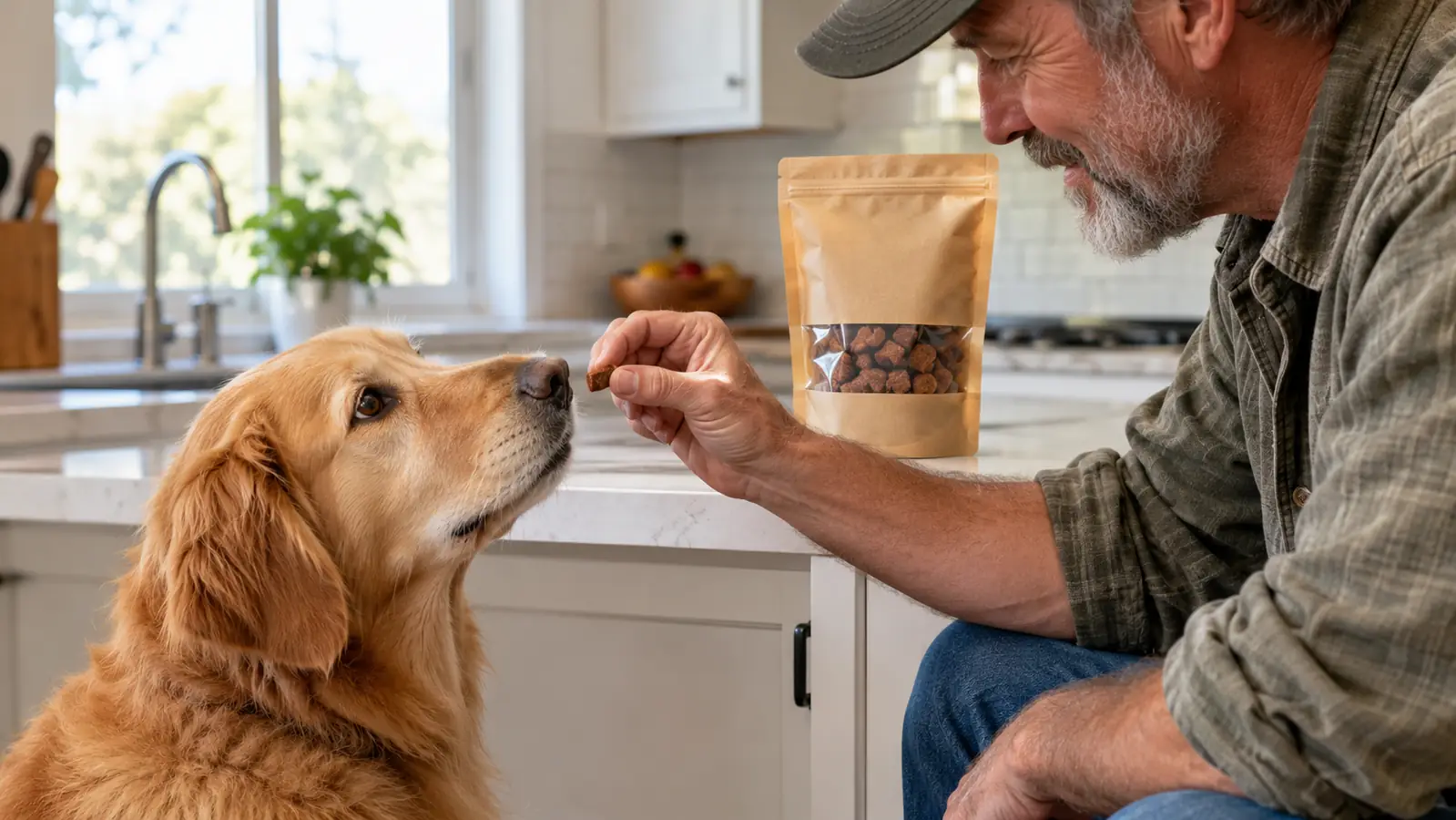
Here is the mistake I made with my first dog, years before Maisie. I would hold the treat up in the air and wave it while I called her. She learned to come only when she could see the food. The treat was a bribe, not a reward. The fix is simple: keep the treats hidden in your pocket or a pouch, call her, and produce the treat only after she arrives. If she can see it before she does anything, she is not learning to come when called. She is learning to come when she sees chicken.
With Blue Buffalo Bits, this is easy because they do not crumble in your pocket and they do not have a strong smell that gives them away. I keep a small handful in my jacket pocket during training. Maisie knows it is there, but she does not know exactly when it is coming. That uncertainty is what makes her check in with me more often. She has learned that coming when called might pay off, and that is a stronger pull than seeing the treat in my hand.
Some trainers use a clicker to mark the exact moment the dog reaches you. I do not use one because I found that a consistent word works just as well for us. Pick 'yes' or 'good' and use it the same way every time. The word becomes the promise that a treat is coming, and the treat always arrives within a second or two of the word. That timing matters more than people think.
Step 3: Add Distance and Mild Distractions
Once Maisie was coming to me reliably across the kitchen, I moved the practice to the living room, then to the backyard, then to the front yard on a long line. That is the order that worked: indoor, fenced outdoor, then unfenced outdoor. Each move adds something new, and you only take one step at a time. If she stopped coming at any level, I went back a step and practiced there for a few more days.
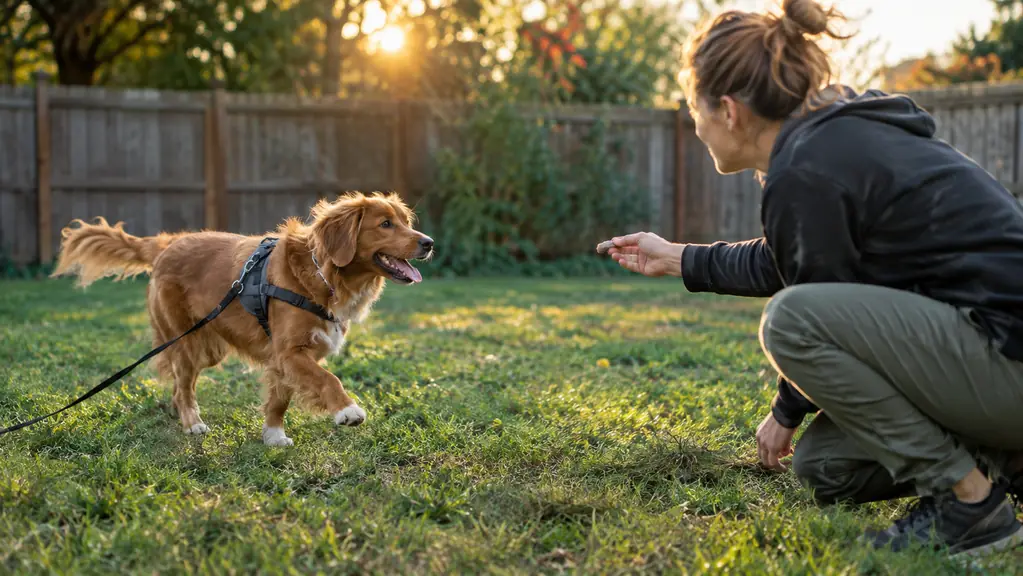
The long line is non-negotiable for the unfenced part. I used a 30-foot line from the feed store, the kind meant for a horse. It gives her room to wander while I still have control if she ignores me. When she did ignore me, I did not yank the line. I waited a beat, gave a gentle tug, and tried again. The point is not to punish. The point is to show her that the command still applies, even with a squirrel across the street.
Distractions need to be added gradually. I started in the backyard when the neighbors were not out. Then I practiced when I could hear kids playing a few houses down. Then I practiced during the evening walk, on the leash, at the park. Each level of distraction is a new lesson, and the reward has to be worth more than the distraction. Blue Buffalo Bits are chicken flavored, and for Maisie that outranks most of what she can smell on the ground.
Step 4: Practice Outside on a Long Line
The backyard was my classroom for the next two weeks. I let Maisie drag the 30-foot line while she sniffed around the fence, and I called her at random moments. Sometimes she came right away. Sometimes she looked at me like I was interrupting something important. When she hesitated, I gave the line a soft tug and called again. When she arrived, she got a treat and plenty of praise.
The key is what happens after the treat. I let her go right back to sniffing. If coming to me always ended the fun and sent her inside, she would learn to avoid me. Coming to me had to be the start of something good, not the end of something better. So I would treat her, tell her she was a good girl, and let her go back to whatever she was doing. That single habit made more difference than anything else in the whole plan.
Once she was coming consistently in the backyard, I moved to the front yard with the line still attached. The street added a whole new level of distraction. I kept the line shorter at first, about 15 feet, and I practiced at quiet times of day. Each small success built on the last one. By the end of the month, she was coming when called across the yard even with the neighbor's dogs barking.
Step 5: Make Coming to You Always Pay Off
By this point Maisie knew the game. She would come when called because she had learned that coming paid. But I still had to protect that trust. The fastest way to ruin a recall is to call your dog to you and then do something she hates, like give her a bath or trim her nails. If that has to happen, go get her instead of calling her. The recall has to mean only good things, every single time.
I also started varying the reward. Sometimes she gets one Blue Buffalo Bit. Sometimes she gets three. Sometimes she gets praise and a quick game of tug. She never knows which call will pay big, so she never skips a call. That unpredictability is what makes the behavior stick. Dogs, like people, will keep doing something when the payoff is not always the same size.
One more habit that helped us: I call her for no reason at all, several times a day. From the kitchen, from the living room, from the back step. She comes, gets a treat, and goes back to her business. That keeps the behavior fresh, so she does not only hear 'come' when it is time to leave the park or go inside. The treat appears from my pocket, she gets it, and she is free to go back to whatever caught her nose. That freedom is part of the deal.
What Else Helps
Two things made this process easier than it could have been. The first is a consistent schedule. We do a short training session every morning after breakfast, before the day gets busy. Five minutes is enough. The second is keeping the treats where I can reach them. I refill a small pouch every Sunday so I am never digging through my coat pockets for a crumb when Maisie is already looking at me.
Also, pay attention to your dog's stomach. Maisie has a sensitive one, so I count every treat she gets in a day, training included. Blue Buffalo Bits are small enough that a full session costs very few calories, and that lets me train every day without worrying about her weight. A dog who trusts that coming to you is a good deal will choose you almost every time.
One more thing: do not practice recall only when you need it. If the only time you call your dog is to end something fun, the word starts to mean 'fun is over.' Call her during the walk, treat her, and let her keep walking. Call her in the middle of fetch, treat her, and throw the ball again. She learns that coming to you is never a dead end.
Coming to me had to be the start of something good, not the end of something better.
Maisie still does not have a perfect recall. No dog does. But she comes when I call her now, even when the neighbor's cat is sitting on the fence, and that is a world of difference from where we started. If you put in five minutes a day for a few weeks, you can get there too. Pick a quiet corner of your house, fill your pocket with something small and soft, and start tonight.
Five Minutes a Day Is All It Takes
A 4 oz bag of Blue Buffalo Bits lasted me through weeks of recall practice, and Maisie's stomach handled them fine. If you want a recall you can trust, the first step is a treat your dog will work for. Check today's price on Amazon.
Amazon Check Today's Price on Amazon →