

I have fed Maisie, my 26 lb beagle mix, a handful of Blue Buffalo Bits every single day for months. Not just on training days. Every day, because a beagle who lives for food will do almost anything for a soft treat, and that made her the perfect test subject for a long-term review. She has a sensitive stomach, so whatever I give her has to earn its place in the routine.
I was skeptical at first. Training treats are usually either too crumbly to be worth the mess or too rich for a dog who gets an upset stomach from the wrong ingredient. Blue Buffalo Bits sat in my pantry for a week before I opened them. Now I keep a bag in the kitchen drawer next to the measuring cups, and Maisie knows exactly where that drawer is.
The Quick Verdict
Blue Buffalo Bits are the training treat I keep coming back to because they are soft enough to break into small pieces, gentle on a sensitive stomach, and consistent bag after bag. They are not the cheapest treat on the shelf, and the 4 oz bag does not last forever when you train daily. But for a food-motivated small dog, they do the job every single day.
Amazon Check Today's Price →A soft training treat that earned a permanent spot in my kitchen drawer
After months of daily use, Blue Buffalo Bits are the treat I reach for first. Check today's price on Amazon and see if they fit your dog's routine.
Amazon Check Today's Price on Amazon →How I've Used It
My routine with Maisie is simple. Morning walk around the neighborhood, evening walk around the neighborhood, backyard fetch when the weather cooperates, and short training sessions in the kitchen. The training sessions are where Blue Buffalo Bits earn their keep. We work on sit, stay, and the come command, and I use maybe ten to fifteen pieces a session.
The first thing I noticed is that the pieces are small, about the size of a pea, which is exactly what I want for a 26 lb dog who would happily eat her own weight in treats. Because they are so small, I can use them generously without blowing past her daily calorie budget. That matters a lot for a beagle, a breed that will eat until it hurts and then ask for more.
I also use them as a topper on her kibble a couple of times a week. A few bits crumbled over her dinner bowl turns a meal she eats slowly into a meal she finishes in two minutes. I do not do this every day, because I want her to stay interested in the plain kibble too. But it is a good tool to have when she goes through a picky phase.
Before I settled on Blue Buffalo Bits, I tried a couple of other things first. The oven-baked biscuits from the grocery store crumbled into gravel in my jacket pocket by the second block, and Maisie would pick the pieces up, chew once, and spit them out on the sidewalk. Then I tried a soft stick-style treat that she loved a little too much. It gave her loose stools within a day, and I pulled it from the rotation after one bad night. That is the history that made me careful. When I finally opened the first bag of Blue Buffalo Bits, I started with just three pieces on a Sunday morning to see how her stomach handled them. She ate all three, licked the floor, and looked up at me for more. By Wednesday I was confident enough to use them for a full training session.
On a typical morning I count out twelve pieces before we leave the house. Twelve pieces gets us through the whole loop, with a reward for a good heel at the corners and a piece for staying calm when a yard dog barks at us through the fence. The evening session in the kitchen is shorter, maybe ten pieces, because she is already tired and I want her to end the day on a win. I keep the bag in the drawer, scoop a small pile into a bowl, and leave the bowl on the counter so I am not digging around with cold hands at six in the morning.
One place I deliberately do not use Blue Buffalo Bits is backyard fetch. Fetch is its own reward for Maisie, and I want her to stay crazy about the game for its own sake, not because it pays out treats. So the treats stay in the kitchen drawer during fetch, and the game stays pure. That is part of managing the daily treat budget too. By keeping treats only for walks and training, I can use a generous handful when it really matters without worrying about the total for the day.
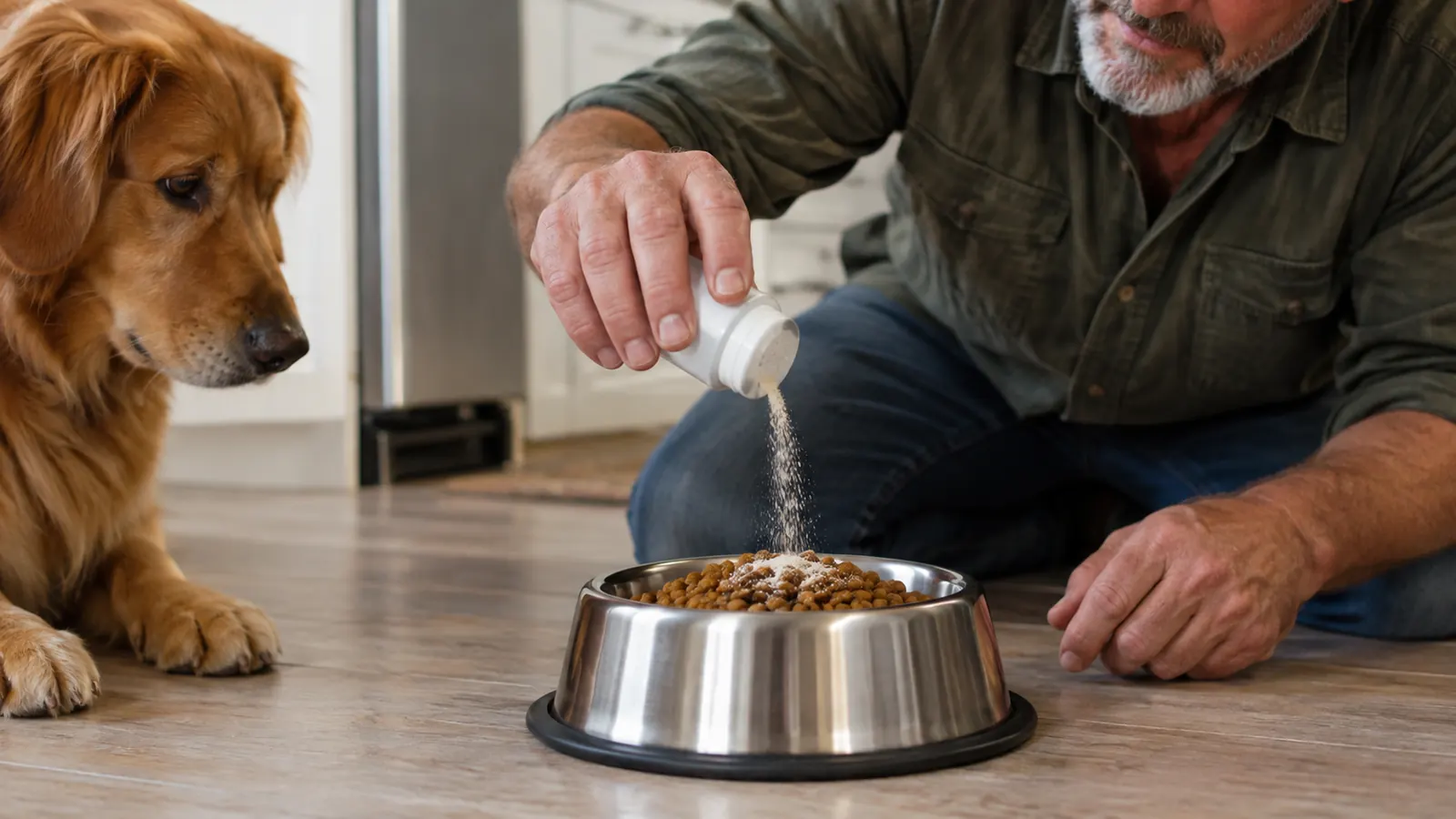
What Goes Into Blue Buffalo Bits
Blue Buffalo is one of the few brands I trust enough to feed daily without reading the label ten times. The first ingredient is deboned chicken, and the list is short enough that I can actually pronounce everything on it. There are no corn, wheat, or soy fillers, which matters because Maisie's stomach is the final judge of any treat that enters this house.
The texture is what surprised me most. They are soft and chewy, not crumbly, which means I can break one piece into three smaller pieces without it turning into dust in my pocket. That is the detail that makes them work for training. A treat that crumbles the moment you pull it out of your pocket is a treat you stop carrying. Blue Buffalo Bits stay intact through a whole morning walk.
The smell is mild, which I appreciate. Some training treats smell strong enough to linger on your hands for an hour. These have a light chicken scent that does not take over the kitchen. Maisie still knows they are in my pocket before I even reach for them, because a beagle's nose does not miss much.
I read the label the way a retired school bus driver reads a permission slip: slowly and twice. The first ingredient is deboned chicken, followed by chicken meal, and then a short list I can actually pronounce. There is no corn, no wheat, no soy, and no by-product meal, which matters more to me than any marketing claim on the front of the bag. I also checked the guaranteed analysis on the back. Crude protein is 18 percent, crude fat is 7 percent, crude fiber is 3 percent, and moisture is 24 percent. For a treat that Maisie eats every day, those numbers are reasonable, and they line up with what I expect from a chicken-based soft chew.
The other thing I checked was the piece size, because a 4 oz bag of pea-sized bits is a different product than a 4 oz bag of big soft cubes. I weighed a single piece on my kitchen scale: one piece is about a third of a gram, which works out to roughly three hundred pieces in a 4 oz bag. That is important math for me, because it tells me how to plan: at a dozen pieces on a walk and ten more in the kitchen, a bag lasts us about two to three weeks. It also tells me Maisie is not getting too many calories. At about a calorie and a half per piece, a full day of training adds maybe forty-five calories, which is a small slice of her daily allowance for a 26 lb dog.
How They Held Up Over Months of Daily Use
I have bought several bags over the past few months, and the consistency has been the most impressive part. The pieces in the latest bag look and feel exactly like the pieces in the first bag. The texture has not turned dry or hard, the smell has not changed, and the bag stays fresh to the last piece. That kind of consistency is harder to find than you would think.
Maisie's stomach has stayed calm the whole time. No soft stools, no vomiting, no scratching at her ears. For a dog with a sensitive stomach, that is the review that matters most. I have had to pull other treats out of the rotation because they gave her gas or loose stools. Blue Buffalo Bits have never once caused a problem.
One thing I will say honestly: the 4 oz bag does not last long if you train every day. I go through a bag in about two to three weeks. That is not a complaint about the product, it is a reality of using a small-piece treat for daily training. I plan for it by buying a couple of bags at a time.
I started my first bag in early November, right after a vet visit where Maisie got a clean bill of health and I asked about her weight. The vet said she was right where she should be for a 26 lb beagle mix, and she reminded me that treats count toward the daily total. That is when I started keeping a little tally on the fridge: every piece she got, I marked down. It sounds fussy, but it kept me honest, and it is the reason I can tell you exactly how long a bag lasts. By the end of the month I had a full page of tallies, and the pattern was clear: steady use, no surprises, no midnight trips outside because of an upset stomach.
There was one rough stretch in December. Maisie came down with a mild stomach bug after she got into something on a walk, and I stopped all treats for four days to let her settle. When I brought the Blue Buffalo Bits back out, I started with two pieces instead of a full handful. No reaction. By the end of the week she was back to her normal routine, and the treats had nothing to do with the upset. That mattered to me, because it told me the bag itself was not the problem. I have also left a bag open on the counter overnight by accident, and the pieces were still soft the next morning, which is more than I can say for a biscuit I once left out.
Maisie's stomach has stayed calm the whole time. No soft stools, no vomiting, no scratching at her ears. For a dog with a sensitive stomach, that is the review that matters most.
How the Pieces Work for Training
The size of each piece is the real selling point. At about the size of a pea, one piece is enough to reward a correct sit without giving her so much food that she loses interest in the next repetition. When we are doing a longer session, I break pieces in half to make the bag last longer and keep her working.
Blue Buffalo Bits are also easy to carry. I drop a small handful into a pocket before a walk and they do not leave a greasy stain or a crumb trail. That is a small thing, but it is the difference between actually carrying treats on every walk and leaving them on the counter at home.
The only training downside I found is that they are not high-value enough for the hardest distractions. When another dog walks past the yard, Maisie's nose takes over and no pea-sized treat is going to compete with that. For everyday training around the house, they are perfect. For emergency recall in the middle of a squirrel chase, I need something stronger.
The training moment that sold me on the size happened in the kitchen one evening in January. I was teaching Maisie to wait at the back door before going into the yard, which is a hard skill for a beagle because the whole world smells like rabbits. I had twelve pieces lined up on the counter, and I went through all twelve in about four minutes. She held the wait for a full ten seconds by the end, which for her is a very long time. With a bigger treat, I would have been pausing the whole exercise to let her chew, and the wait would have fallen apart. The pea size keeps the rhythm of the session going.
Loose-leash walking is where the small size pays off in a different way. On our morning loop, I reward Maisie every time she looks back at me without being asked, which trainers call a check-in. Those check-ins happen maybe a dozen times on a good walk, and each one gets a single piece. If the treat were bigger, I would have to choose between overfeeding her or skipping rewards, and the walking would get sloppier. As it is, I can reward every check-in and still keep the total for the whole walk under a dozen pieces. That is the whole job of a training treat: it has to be small enough that you can use it as often as the behavior deserves.

Pros and Cons
What I Liked
- Soft, chewy texture that breaks into smaller pieces without crumbling
- Gentle on a sensitive stomach after months of daily use
- Small pieces are perfect for training without blowing the calorie budget
- Short ingredient list with deboned chicken first
- Consistent bag after bag with no dry or hard pieces
- Mild scent that does not linger on your hands
Where It Falls Short
- 4 oz bag goes quickly with daily training, about two to three weeks for us
- Not a high-value treat for the most distracting moments
- Costs more than basic supermarket training treats
Who This Is For
Blue Buffalo Bits are for the everyday one-dog household where training is part of the routine. If you have a food-motivated dog who will work for a soft treat, if you do short training sessions in the kitchen or on walks, and if you want a treat that will not upset a sensitive stomach, these are worth trying. They are especially good for small to medium dogs, since the pea-sized pieces are portioned for a 26 lb mouth.
Who Should Skip It
Skip Blue Buffalo Bits if you need a high-value treat for serious distraction work, if you have a large dog who needs a bigger reward to feel motivated, or if you are on a tight budget and go through treats faster than a 4 oz bag can keep up. For those situations, a larger jerky-style treat or a roll of soft training sausage might serve you better. There is no single perfect treat for every dog, and this one is no exception.
The treat that made it into my daily rotation
Months later, Blue Buffalo Bits are still the first thing I reach for. See today's price on Amazon and decide if they belong in your kitchen drawer too.
Amazon Check Today's Price on Amazon →