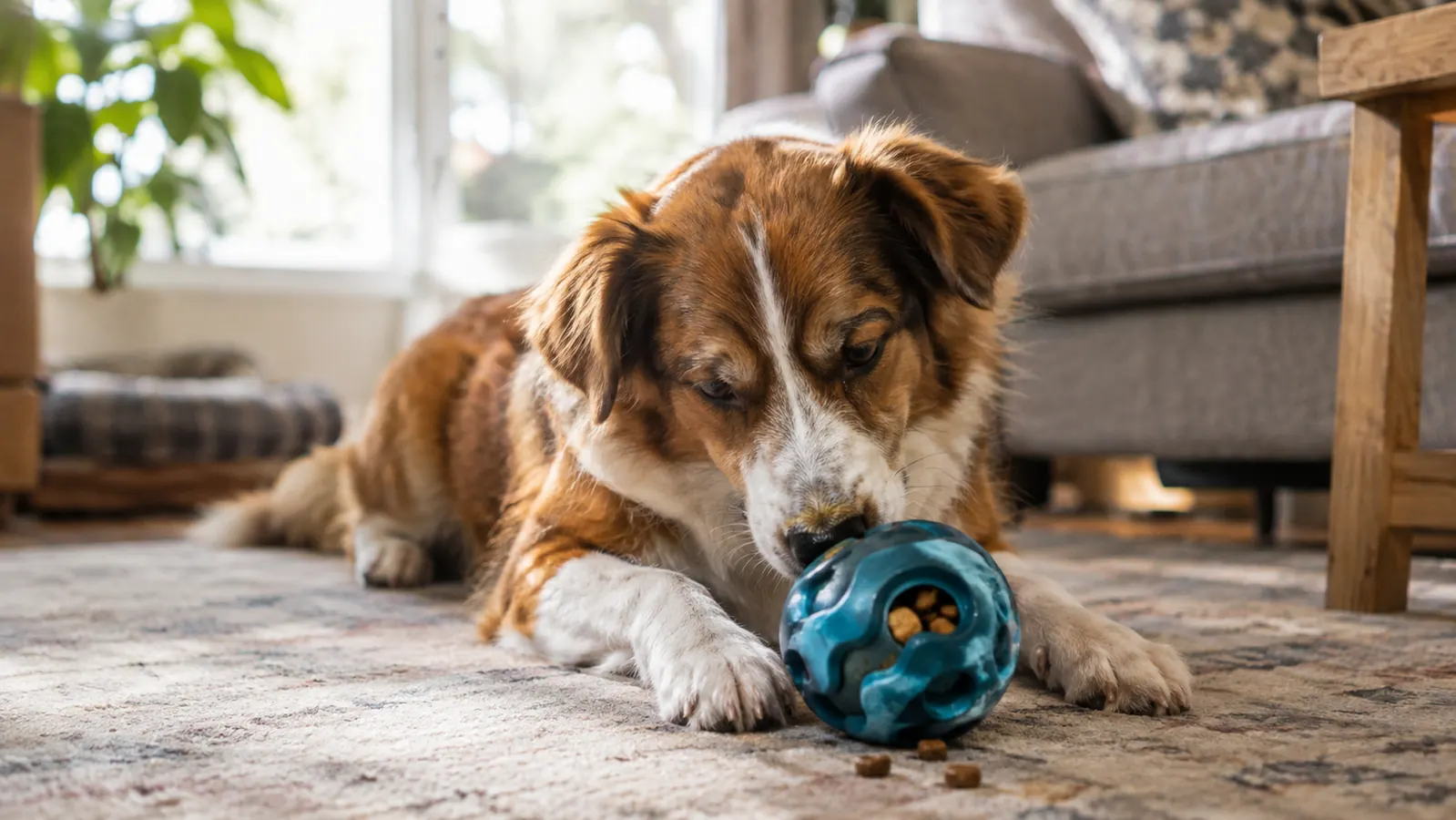
Some days it feels like Maisie has one speed: busy. She gets her morning walk. She gets her evening walk. She gets fetch in the backyard until my arm gives out. And still, by 2 in the afternoon, she is standing at my elbow with that look that says, "You have been sitting still for twelve whole minutes and I find that unacceptable."
I tried a lot of things before I found what works. More walks helped a little. More fetch helped a little. But the thing that actually keeps her busy indoors, for real, for more than ten minutes at a stretch, is a treat-dispensing toy. Not a stuffed animal she can shred in one sitting. Not a bone she loses under the couch. A KONG Wobbler, the kind she has to knock around to make the kibble fall out. This guide is the exact routine I use, step by step, so you can get the same result without the trial and error.
The toy that finally wears out a busy dog indoors
The KONG Wobbler is the treat-dispensing toy I reach for on every rainy day and every work-from-home afternoon. It holds a decent amount of kibble, it is sturdy enough to survive a determined dog, and it keeps Maisie busy while I get things done. See today's price on Amazon.
Amazon Check Today's Price on Amazon →Step 1: Pick the right size and the right treats
The KONG Wobbler comes in two sizes. I use the medium/large size for Maisie, who is about 26 pounds. If you have a small dog, get the small size. If you have a big dog, get the large. The right size matters because the opening is sized to match. A toy that is too small for your dog will be too easy to tip over, and a toy that is too big will be frustrating to push around.
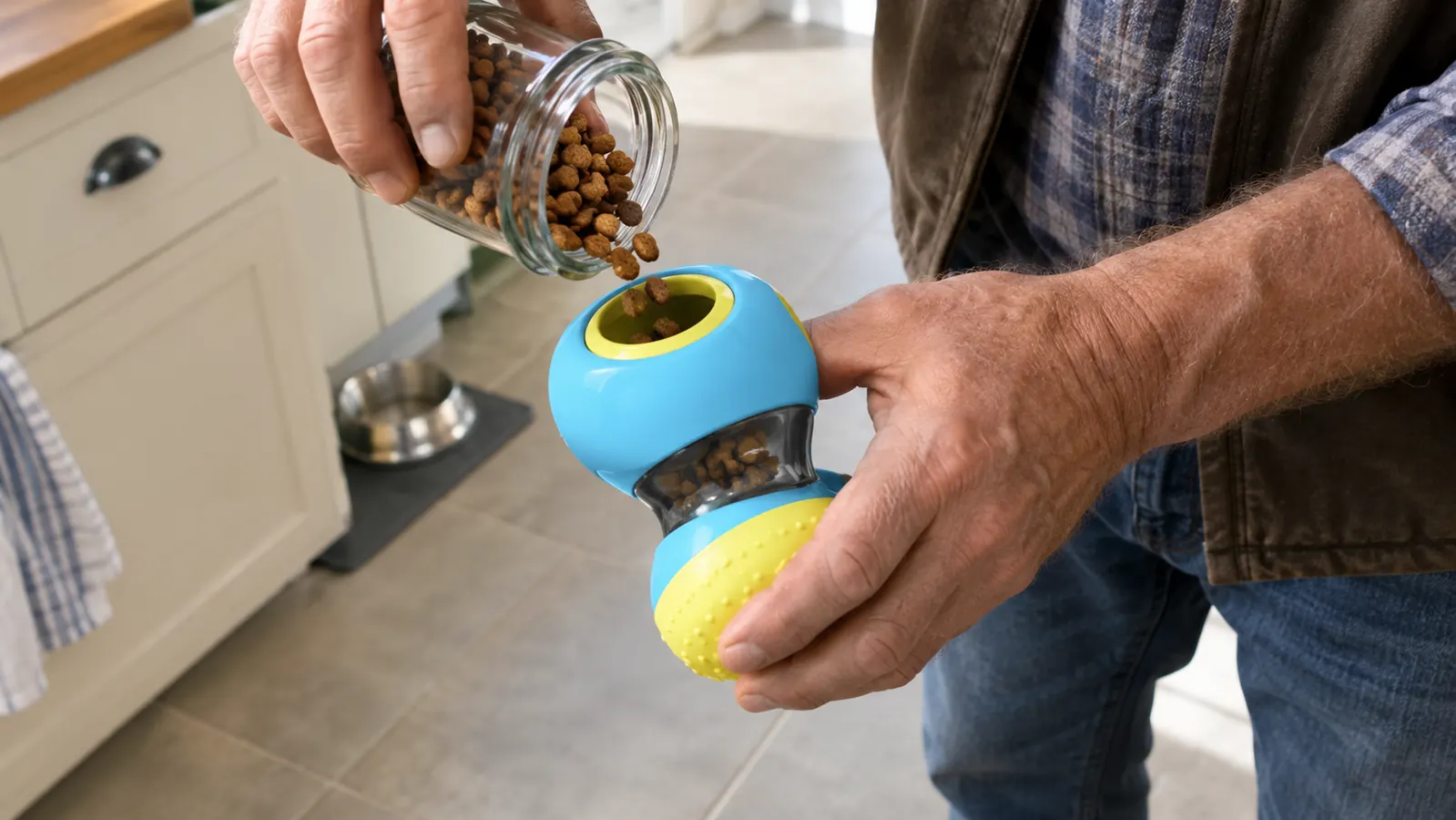
What you put inside matters just as much as the toy itself. I use Maisie's regular kibble most days. It is the same food she eats at dinner, so I am not adding extra calories or upsetting her sensitive stomach. I learned that the hard way last winter, when I filled the Wobbler with soft chewy treats instead. Maisie finished the whole thing in about four minutes, spent the rest of the afternoon licking the inside, and her stomach was off the next morning. Now I measure out a quarter cup of her regular kibble, which is about a third of her breakfast portion, and I count every training treat I add against her daily total. The goal is to make the toy worth working for, not to turn it into a full meal that replaces her dinner.
One thing I learned the hard way: start with the easiest setting. The KONG Wobbler has an adjustable opening at the bottom. If you twist it to the widest setting, the kibble falls out easily and your dog gets the hang of it fast. If you start with the narrowest setting, your dog might get frustrated and give up. You can tighten it later once they understand the game.
Step 2: Show your dog how the toy works
Dogs are smart, but they are not born knowing how a treat-dispensing toy works. The first time I put the KONG Wobbler on the floor, Maisie stared at it like it was a strange alien object. She sniffed it, nudged it once, and then looked at me as if to say, "The food is inside, and I am outside, and I do not see how this is my problem."
So I showed her. I tipped the Wobbler over with my hand so a piece of kibble fell out. She ate it. I tipped it again. She ate that too. After three or four tips, she figured out that when the toy tips, food comes out. Then she started nudging it with her nose on her own. That first successful nudge, the moment she heard the kibble rattle and saw it drop, is one of my favorite memories with her.
If your dog is hesitant, stay right there with them. Sit on the floor, tip the toy for them, cheer when they eat the treat. The point of this step is to build confidence. The first day, Maisie quit after two minutes and walked off to her bed. I almost put the Wobbler away for good. The next morning I tried again, this time sitting on the kitchen floor with her, and she nudged it three times before she looked up at me with her tail going. By the third session she was knocking it across the linoleum. It took three days, not one, and that is completely normal. For most dogs it takes one session, but for a few it takes two or three. Either way, be patient.
Step 3: Start with short sessions and easy settings
The first few times you use the KONG Wobbler, keep the sessions short. Five minutes is plenty. You want your dog to end the session still interested, not exhausted and frustrated. Think of it like teaching a kid to ride a bike. You do not send them down a hill on day one. You let them wobble around the driveway first. I set a timer on my phone for the first week, because five minutes feels longer than you think when you are watching a dog work a puzzle, and it is tempting to let them keep going.
I keep the opening wide for the first week or two. Maisie gets a piece of kibble with every nudge, which keeps her motivated. Once she was comfortable, I started twisting the opening a little narrower. Now she has to work a little harder for each piece, and the session lasts longer. The adjustable opening is the whole reason I recommend the KONG Wobbler over a plain treat ball. You can change the difficulty as your dog gets better.
A good target is ten to fifteen minutes of steady play. That is enough time to burn mental energy without turning the toy into a chore. If your dog is still going strong after fifteen minutes and you want them to keep going, you can always add a few more pieces of kibble. But I like to end on a high note, with my dog still wanting more.
Step 4: Make it part of your daily routine
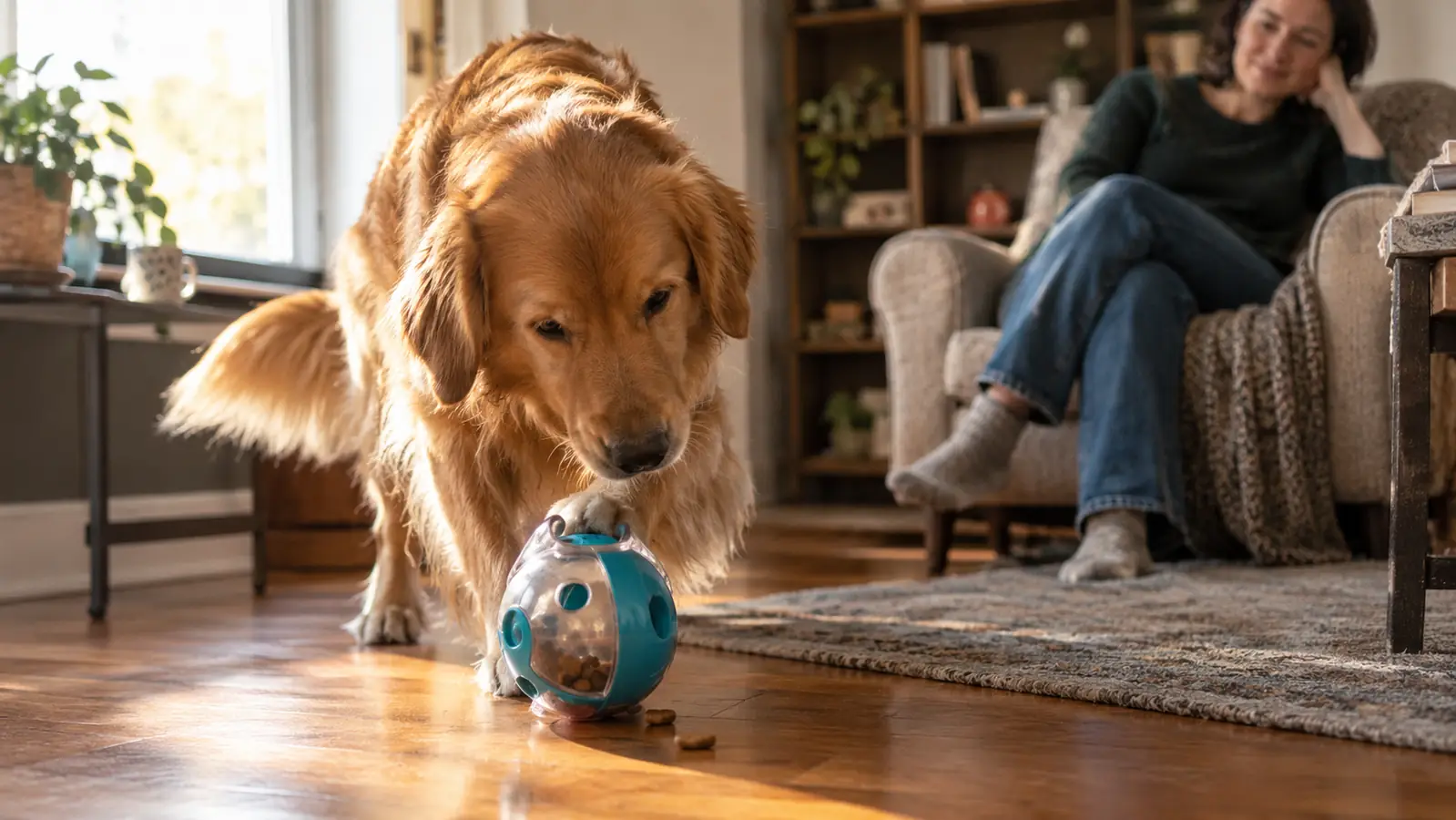
The treat-dispensing toy works best when it is part of a routine, not a one-time trick. In our house, the KONG Wobbler comes out at the same time most days: right after the morning walk. Maisie comes in from her walk, sees the Wobbler on the kitchen floor, and gets to work while I make coffee and pack my lunch. It gives her a job to do and gives me a few quiet minutes to start the day.
It is also my go-to for rainy days. Maisie does not care much for walking in the rain, and honestly, neither do I. Last March we had a stretch of six straight rainy days, and the Wobbler was the only thing that saved us. On the third morning I filled it with her breakfast kibble instead of giving her the bowl, and she worked for a full seventeen minutes before she flopped down on the kitchen rug. That was the morning I stopped thinking of it as a toy and started thinking of it as a tool. A ten-minute session of nudging and chasing the toy around the kitchen floor wears her out in a way that a ten-minute walk never could, because it is using her brain as much as her body.
I also use it when I need to get something done around the house. If I am on the phone, or trying to fold laundry, or doing anything that requires both hands and a clear floor, the KONG Wobbler buys me fifteen minutes of focused time. It is not a replacement for walking or playing with your dog. It is a tool that makes the boring parts of the day easier for both of you.
Step 5: Keep it interesting and clean it properly
Dogs get bored with the same toy every single day, just like people do. I keep the KONG Wobbler interesting by rotating it with a couple of other toys. It comes out two or three days a week, not every day. On the days it stays in the cupboard, Maisie gets a different puzzle toy or a chew. The break keeps the Wobbler feeling fresh, so when it does come out, she is excited to see it. I noticed the difference around the third week. When the Wobbler was out every day, Maisie would give it a few half-hearted nudges and wander off. After a two-day break, she goes at it with the same energy she had on day one.
You can also change what goes inside. Some days I put in her regular kibble. Some days I mix in a few small training treats. Some days I put in a little bit of peanut butter smeared on the inside walls, which makes the kibble stick and turns the whole thing into a longer challenge. Just keep an eye on the total treats for the day, especially if your dog is prone to weight gain or has a sensitive stomach like Maisie.
Cleaning is simple. The KONG Wobbler is dishwasher safe on the top rack, but I usually just rinse it in the sink with warm soapy water and let it dry. You want to clean it regularly because kibble dust and peanut butter residue can build up in the opening. A clean toy works better and stays safer for your dog. Check the bottom opening every few weeks to make sure it still turns smoothly.
What Else Helps
The KONG Wobbler is the centerpiece of my indoor busy-dog routine, but it is not the only thing that helps. A frozen KONG stuffed with peanut butter and kibble is a great option for when you need a longer stretch of quiet, like when you are on a long phone call or trying to get dinner on the table. I make mine the night before, fill it with a spoonful of peanut butter and a handful of kibble, and stick it in the freezer. It buys me about twenty-five minutes, which is exactly how long it takes me to get dinner on the table. A snuffle mat is another good one. You hide kibble in the folds and your dog uses their nose to find it. It is a different kind of mental work, and some dogs love it even more than a puzzle toy. I only bring the mat out on weekends, because Maisie gets so focused on it that she needs a nap afterward, and a full mat takes her about twelve minutes to clear.
Short training sessions in the kitchen also help. Five minutes of sit, down, stay, and come uses more mental energy than you would think. I do a quick session with Maisie most evenings, using a few pieces of her dinner kibble as rewards. It is not exercise, but it is engagement, and an engaged dog is a tired dog. If you pair a few of these things together, you can cover a whole rainy afternoon without a single shredded pillow.
A ten-minute session with the KONG Wobbler wears Maisie out more than a ten-minute walk, because it is using her brain as much as her body.
Give your dog a job to do, starting today
The KONG Wobbler is sturdy, adjustable, and simple enough for any dog to learn in one session. It has been a regular part of our routine for months, and it is the first thing I reach for when Maisie needs something to do indoors. Check today's price on Amazon and see if it works as well for your dog as it does for mine.
Amazon Check Today's Price on Amazon →