
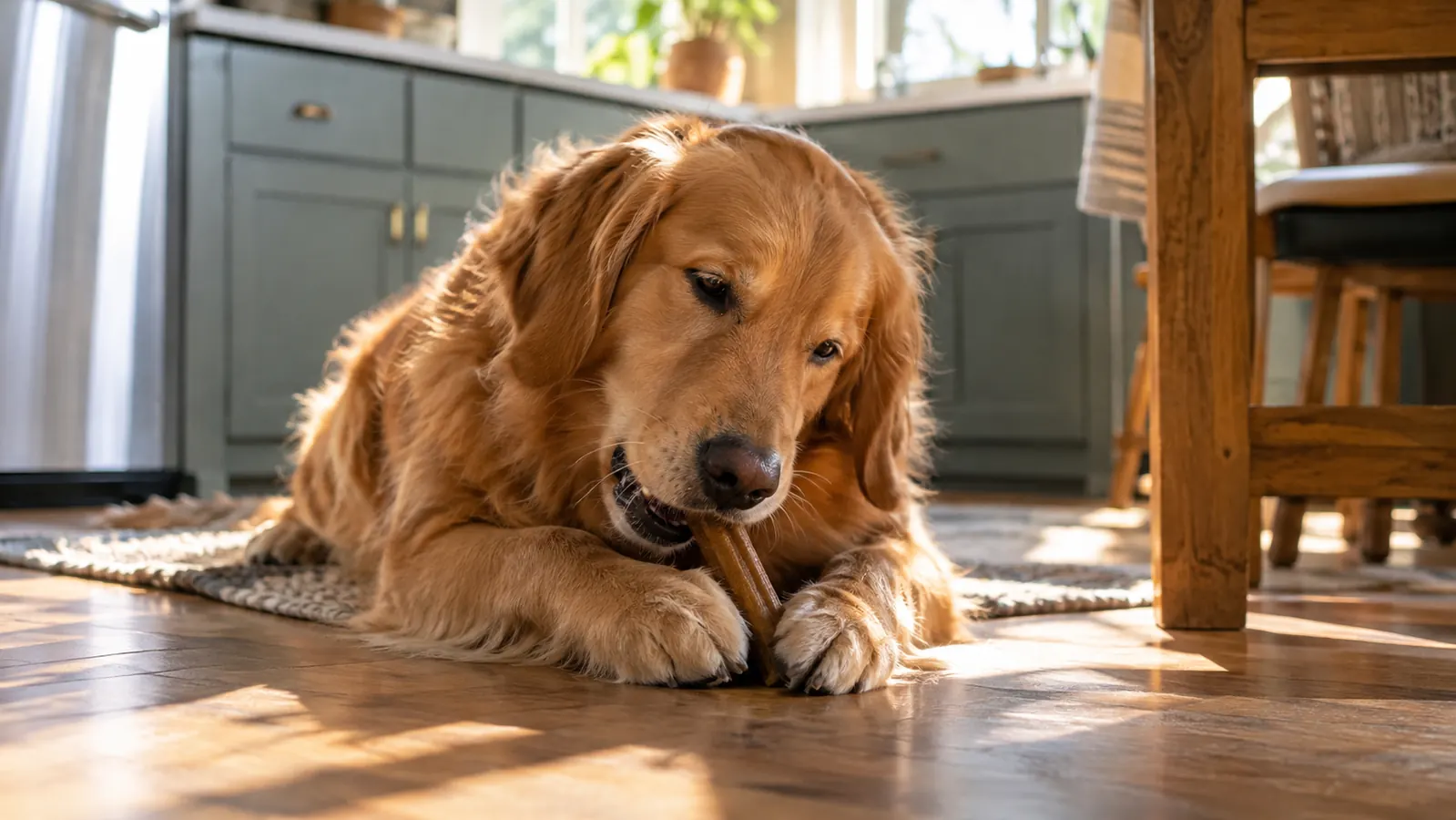
Most reviews of Dentalife are written after a week or two, and they are mostly praise. That praise is true as far as it goes, but it is not the whole truth. After months of giving Maisie a Dentalife chew almost every single day, I have opinions that do not fit in a five-star box. Some of them are good opinions. Some of them are the kind you only get after you have bought the 40-count box twice and started noticing things.
Maisie is a 5-year-old beagle mix, about 26 pounds, and she has a sensitive stomach that has ended more than one treat experiment in a midnight walk I did not want to take. So when I tell you Dentalife chews have been fine for her digestion, that is not a small compliment. That is the highest bar she has. But fine for her stomach is not the same as perfect for her teeth, and that difference is what this whole review is about.
The Quick Verdict
A solid everyday dental chew that keeps tartar from building up and agrees with sensitive stomachs, as long as you know it's a helper, not a replacement for brushing.
Amazon Check Today's Price →What I Liked
- Long-lasting chew that keeps a food-motivated dog busy for several minutes
- Ridged, nubby shape works on the back teeth she actually chews with
- Has been easy on a sensitive stomach with one chew a day
- Short daily habit that is easier to keep than nightly brushing
- Small to medium size fits a 26 pound dog well
Where It Falls Short
- Gets soft and sticky as it is chewed, so the last piece needs watching
- Leaves crumbs on rugs and couch cushions
- Costs more than basic dental treats
- Inner bag does not reseal well once opened
- Does nothing for tartar that has already hardened
If you want a daily chew that actually gets eaten and keeps tartar down, this is the one I keep buying.
After months of daily use, Dentalife is still the chew Maisie finishes without hesitation. It's the treat I reach for when I want something that does more than taste good.
Amazon Check Today's Price on Amazon →How I've Used It
Maisie gets one Dentalife chew after her evening walk, usually around 6:30, while I'm making dinner. She knows the routine. The second she hears the cabinet where I keep the treats, she's sitting by her bowl with that beagle stare that could melt glass. The chew lasts her anywhere from ten to fifteen minutes, which is longer than most treats she gets, and that chewing time is exactly why it works.
I started with the small to medium size because the package says it's for dogs up to about 25 pounds, and Maisie is right at that edge. The fit matters. A chew that's too big is hard for her to grip, and one that's too small disappears in three bites and does nothing for her teeth. The small to medium size is the one that hits the sweet spot for a dog her size.
What surprised me is how much she actually chews it. With some dental treats, she crunches once and swallows. With Dentalife, she works it. She holds it with her front paws and gnaws on one end, then the other, then goes back to the first end. That repeated gnawing is what scrapes the plaque off, so the fact that she doesn't inhale it is the whole point.
I timed her one evening in early March, just out of curiosity. She started at 6:32 and the last piece went down at 6:46. Fourteen minutes of actual chewing. That is longer than any biscuit she has ever eaten, and it is the reason I keep coming back to this particular chew. A treat that is gone in forty-five seconds cannot do much for her teeth no matter what the bag claims.
One more detail from that evening: she chewed on the left side of her mouth for most of the first two minutes, then switched to the right when the chew got softer. I had never paid attention to which side she favors before. It made me realize the chew is only cleaning the teeth she actually uses on it, which is another reason I do not think of Dentalife as the whole dental plan. It is a daily helper for the back teeth she chews with, and that is still worth something.
What Nobody Tells You About the Texture
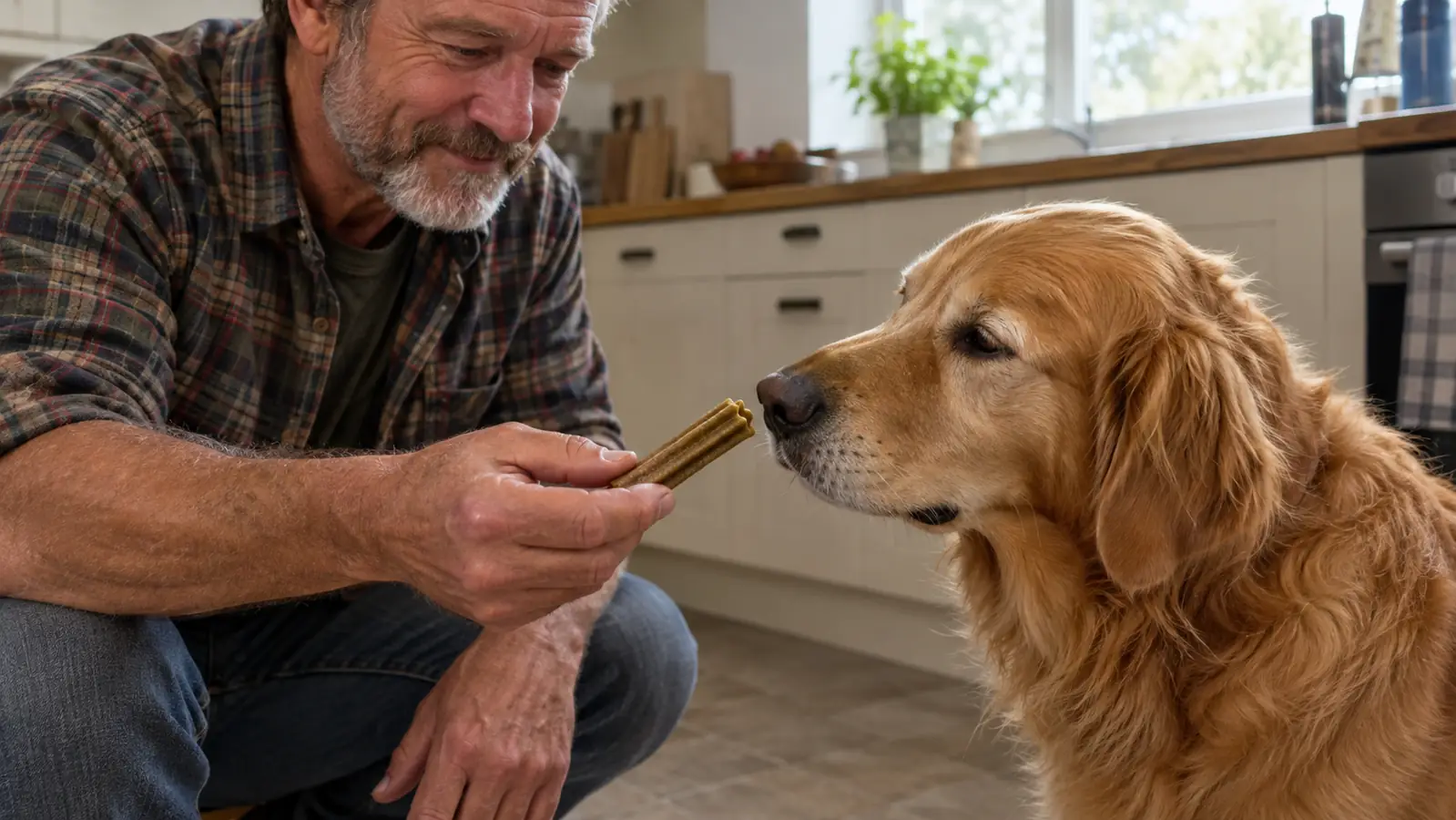
Here's the thing nobody puts on the box: Dentalife chews are not crunchy like a biscuit. They're more like a firm, slightly chewy strip that softens as the dog works it. The surface has those little nubs and ridges, and those ridges are what do the cleaning. As Maisie chews, the nubs press against her teeth and wipe off the soft film that turns into tartar if you leave it alone.
But that texture means you have to watch the first few times. Maisie figured it out fast, but a dog that tries to swallow a chew whole instead of chewing it is going to have a bad time. I don't leave her alone with one. She's a small dog and the chew is bigger than a bite, so I stay in the kitchen while she works on it. That's not a knock on the product, it's just how I handle any treat that takes more than thirty seconds to eat.
The other thing about the texture: it leaves crumbs. Not a lot, but more than a biscuit does. Maisie usually eats hers over her bowl or on the kitchen floor, and I sweep up a little pile of light-colored crumbs afterward. It's a minor thing, but if you're someone who hates crumbs on the couch, this is not a couch treat.
I also learned the hard way that the chew softens as it goes. The first time I gave her one, I came back from checking the mail and found her working on a piece that had gone gummy and was sticking to her paw. She was fine, but I realized then that the last few minutes of the chew are messier than the first few. If you give it on carpet, you will be scrubbing a spot. I give it to her on the kitchen floor and it is a nonissue.
Since then I have a small routine. I hand her the chew on the kitchen mat, not the living room rug, because the softened end gets sticky and picks up dog hair if she drops it on carpet. I stay in the room for the first few minutes, usually while I rinse the dinner dishes, and I take back any piece that gets down to about the size of my thumbnail. That last step matters most for a dog like Maisie, who would rather swallow a small piece than keep working on it. It adds maybe two minutes to my evening and I no longer worry about it.
The nubs and ridges are what do the cleaning. A smooth treat just tastes good; a textured one actually scrapes the plaque off.
The Teeth Part: What I Actually Saw
I want to be honest about what I can and cannot see. I am not a veterinarian. I can't tell you if Maisie's teeth are clinically cleaner. What I can tell you is what I noticed when I looked in her mouth, and I have been looking in her mouth every Sunday for months now, the same way I check her ears and her paws.
Her back teeth, the molars, look better than they did before we started. The film that used to build up on them by the end of the week is not as thick, and her breath is noticeably less offensive in the morning. Her front teeth, the canines and incisors, don't show much difference, because she chews with her back teeth, not her front ones. That's the honest version. The chews help where she actually chews.
The veterinary dentist community talks about dental treats as one part of a routine, not the whole routine. I read that before I bought the first box, and now I understand it from experience. Dentalife does a real job on plaque, but it does not remove tartar that's already hardened. If your dog already has visible brown tartar, a chew is not going to fix it. You need a vet to do that. The chew is for keeping things from getting worse, not for undoing what's already done.
I have a specific memory from last November that keeps me honest about this. Maisie had a small spot of brown on one back molar, and I convinced myself the chews would wear it away. They did not. After three weeks of daily Dentalife, the spot was still there. I took her to the vet, they scaled it off in about two minutes, and the vet said the rest of her teeth looked good. That visit taught me exactly where the chew ends and the professional begins.
Before Dentalife, I tried brushing her teeth every night for about three weeks. I bought the finger brush and the poultry flavored paste, and I meant it. Maisie tolerated it for the first few nights, then started hiding under the kitchen table as soon as she heard the drawer open. By week three I was brushing maybe twice a week, and badly. The chew does not replace brushing, and I still try a quick brush on Sundays, but a chew she runs to is a chew that actually gets used every day, and consistency is what I was missing.
For everyday plaque control that your dog actually enjoys, Dentalife does the job without drama.
It's the treat I reach for when I want something that does more than taste good. If you're looking for a daily dental chew that gets eaten and helps keep teeth cleaner, this is the one.
Amazon Check Today's Price on Amazon →The Sensitive Stomach Test
This is the part where Dentalife earned my trust. Maisie's stomach is the reason we've thrown away half-eaten bags of other treats. Anything with too much fat, too many artificial colors, or too much of an ingredient she can't handle, and we're up at 2 AM cleaning the carpet.
Dentalife has been fine. Not one upset stomach in months of daily use. She eats one a day, and I have never seen her have a reaction. That alone puts it above a lot of treats in our house.
The ingredient list is short, which I like. I'm not going to pretend I can pronounce every ingredient, but I can read it. There's no corn syrup, no added sugar, and the main ingredients are things I recognize. For a treat that she gets every single day, I want it to be as plain as possible, and this is.
One thing I will note: I give her exactly one a day, never two. The first week I had the box, I thought one more would be a nice reward after a long walk, and she had loose stools that night. It could have been a coincidence, but I did not test it again. One chew a day is what the package suggests, and for a dog with a sensitive stomach, that is the number I stick to.
I also count the chew as part of her daily treat budget. Each one has calories, and for a 26 pound dog who also gets training treats on two walks a day, it adds up. On days when we do a longer training session in the backyard, I trim her dinner by a small scoop so the total stays about the same. Her weight has held steady at her last two checkups, and her vet said the same thing I have read elsewhere: keep treats, chews included, to a small slice of the day's food.
What I'd Change
Nothing is perfect, and Dentalife has a few things I'd change if I could. The first is the size range. The small to medium size is right for Maisie, but if you have a dog that's right at the edge of the weight range, you might find yourself wishing for a size in between. The jump from small to medium to large is bigger than it looks on the package.
The second is the crumbs, which I mentioned. They're not a dealbreaker, but they are a fact of life with this chew. If you give it to your dog on the couch, you will be vacuuming the couch. I give it to Maisie in the kitchen for a reason.
The third is the price. Dentalife is not the cheapest dental chew on the shelf, and it's not the most expensive either. It's right in the middle. For a daily treat, that adds up, but I've found the 40-count box lasts us about six weeks, which is reasonable for what it does.
To put the price in plain terms, I look at it per day rather than per box. One chew a day means a 40-count box lasts a little over a month, and I usually order a new one when the bag gets down to about ten. Compared with what I was spending on random dental treats that she either ignored or that upset her stomach, it has actually come out about even, and I throw far fewer half-eaten treats in the trash.
I also wish the box had a better way to reseal. The bag inside is the kind you fold over and clip, and if you do not get the fold just right, the chews at the bottom dry out and get harder. I lost two chews that way in January because I left the clip off overnight. It is a small thing, but when you are buying a 40-count box, you want the last chew to feel like the first one.
Who This Is For
Dentalife is for the everyday dog owner who wants to do something good for their dog's teeth without fighting them twice a day with a toothbrush. It's for the dog who loves a daily treat anyway, and the owner who wants that treat to pull its weight. If your dog is a chewer, if they don't have existing tartar problems, and if you're looking for a maintenance tool, this is a great fit.
It's also for the sensitive stomach crowd. If you've been burned by treats that seemed great until they weren't, Dentalife is about as gentle as a daily chew gets in my experience.
Who Should Skip It
If your dog already has visible tartar or gum issues, skip the chews and go to the vet. A dental chew is not a treatment. It's a prevention tool, and if you're past prevention, you need a professional.
If your dog is a gulper, the kind who swallows treats without chewing, skip it too. The whole point is the chewing, and a dog who doesn't chew won't get the benefit. You'd be better off with a treat that's designed to be swallowed or with brushing.
And if you're looking for a treat that will clean your dog's teeth with zero effort on your part, this isn't it. You still need to look in their mouth, brush when you can, and take them for regular checkups. Dentalife is a helper, not a replacement.
The Bottom Line After Months of Use
I keep buying Dentalife. That's the sentence that matters most. Maisie eats it happily, her stomach is fine, and her teeth look better than they did before we started. It is not a cure for anything, and it won't replace a vet visit, but it does what it says it will do, and it does it without drama.
If you're on the fence, that's my honest answer: it's worth trying. Buy one box, give it to your dog for a month, and look at their teeth. You'll know pretty quickly whether it's working for you.